What is the difference between SAT and digital SAT?
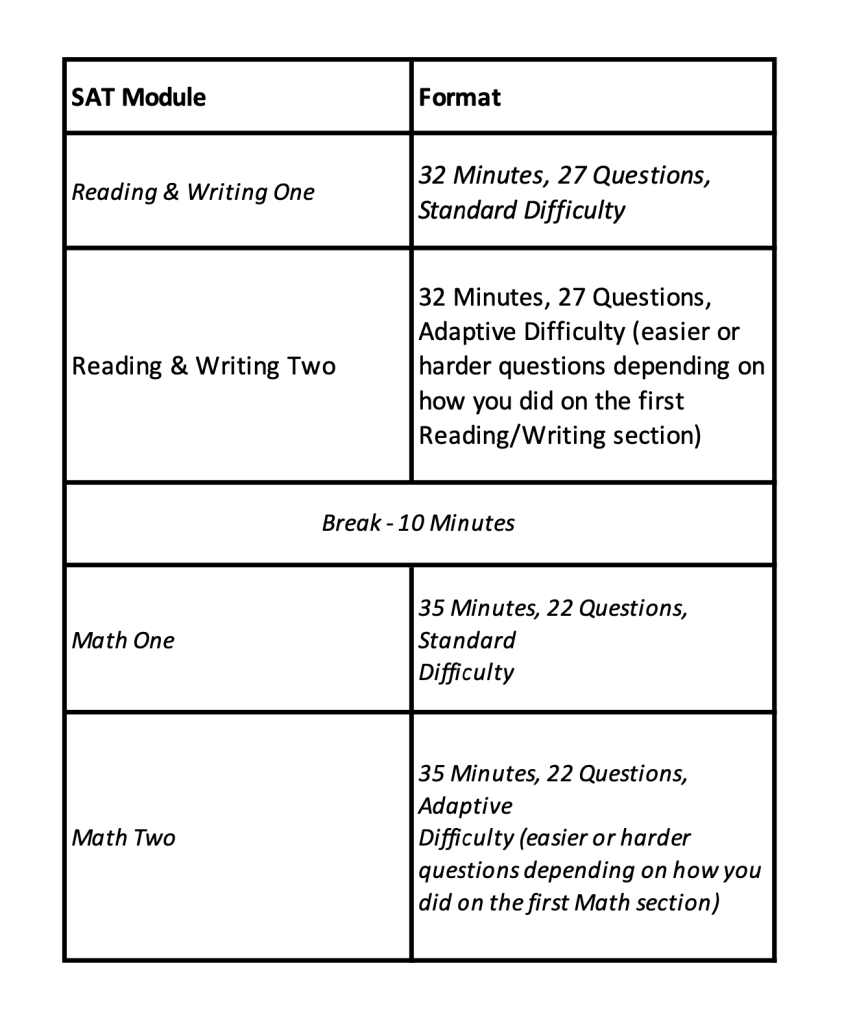
In the paper-based versions of the SAT, Reading and Writing were separate sections, with a few questions added to each long passage. The Digital SAT combines the Reading and Writing sections. The Reading and Writing (RW) section is 64 minutes long and consists of 2 modules, each with 27 passage-based multiple-choice questions. Each short passage (called “text”) or pair of passages (texts) is associated with only one question and the texts can be paired with informative graphics. Some of the texts selected will be from previously published works in world literature or poetry, but most will be short passages written by the College Board and covering history, social studies, and science topics.
The RW section consists of four parts in order:
1. Craft and Structure (≈28%)
2. Information and Ideas (≈26%)
3. Standard English Conventions (≈26%)
4. Expression of Ideas (≈20%)
You will have a total of 70 minutes to complete the math section, which, as mentioned earlier, is divided into two modules (22 questions in 35 minutes each). Most of the questions are multiple-choice, but there are a few questions that the College Board calls student-generated response questions, which we call grid-in questions. In Grid-in questions, instead of choosing from four answer choices, you will need to work through a question and then enter your answer on the screen by typing the appropriate numbers. About 11 of the 44 math questions will be grid-in questions.
The Math section covers four main content areas, but not in this order:
1. Algebra (≈35%)
2. Advanced Math (≈35%)
3. Problem-Solving and Data Analysis (≈15%)
4. Geometry and Trigonometry (≈15%)
What Does It Mean for the SAT to be an “Adaptive” Test?
In order for the digital SAT to take about two hours instead of about three hours, the SAT is now adaptive, meaning that the test changes depending on how the test taker performs. The difficulty of the second modules of both the Reading and Writing section and the Math section will vary depending on how the student performed in the first modules of each section. Students who performed better in the first modules will face more difficult questions in the second modules, while students who did not perform as well will face easier questions in the second modules. Keep in mind that if you move to the more difficult second module of a section, the pace may be more challenging.
Why is the College Board Making These Changes to the SAT?
Adaptive tests have a long history of success. The GRE and GMAT, both used for graduate school admissions, are computer-based adaptive assessments. These tests are shorter than they would otherwise be because they adjust the difficulty of the questions based on student performance.
Students have become more comfortable with computer-based assessments. Digital learning has become much more common during the pandemic with many students studying remotely.
The test should be easier to administer. Test administrators will not have to provide test booklets. If schools want to administer the SATs during the day, they won’t have to take as much time away from the classroom and can offer the test to different groups of students on different days.
Test security should be improved. Since students will have different test questions, it will be much harder to cheat. Also, a test security breach will be much less likely to lead to score cancelations.
Is Digital SAT easier?
Since the digital SAT is intended to measure the skills and knowledge necessary for college preparation and success, it would be meaningless to say that it is easier than the old version. it will continue to measure at the same level as the current SAT.” In other words, the digital SAT is not designed to be easier than the paper-and-pencil SAT. But the College Board says the digital format will make the SAT less stressful and more accessible for students. The test will be shorter, students will be given more time per question, and SAT content will be presented more directly.
Passages on the SAT Reading and Writing section will be shorter, and questions on both sections of the test will be shorter. For many students, this means the questions will be easier to understand.
Another advantage is that in the digital SAT Math section, students will have a built-in graphing calculator to use for the entire section, but students can still bring their own calculator if they wish. Students will also receive a digital reference sheet with common formulas and the option to work on problems.
Is calculator use allowed on the Digital SAT?
The Digital SAT has a built-in calculator that can be used for all Math questions. In addition, students can use their own approved calculators if they prefer. The calculator will be a game-changer on some questions and completely useless on others, so practice with the calculator you plan to use on the actual test so you can take full advantage of this tool.
Is My Calculator Allowed?
Not all calculators are permitted by College Board for use on the SAT. To see the full College Board calculator policy, visit satsuite.collegeboard.org/digital/what-to-bring- do/calculator-policy
Are digital SAT scores higher?
Digital SAT scores will be reported in a few days, not weeks as with the paper-and-pencil test. Your score report for the Digital SAT will include scores for each of the following:
Total Score:
The sum of the two section scores (Reading and Writing, Math) ranging from 400-1600
Section Scores:
Reading and Writing, ranging from 200 to 800
Mathematics, again ranging from 200 to 800
In recent paper-and-pencil versions of the SAT, various sub-scores and cross-test scores have been reported in addition to section and overall scores. On the digital SAT, only the scores listed above will be reported. This means that there will be no information about how you scored in specific subject areas.
What is a Good SAT Score?
There is no “passing” score on the SAT – a good score for you depends on your specific goals for college admission. For detailed information about the typical scores of students admitted to schools in the United States, see this free College Board website:
https://bigfuture.collegeboard.org/
Will Every Question on the SAT be Scored the Same Way?
The College Board is developing a scoring guide that will use the principles of Item Response Theory as it collects more data from test takers – a scoring approach that looks at how you perform on individual test questions in the context of the overall category of test questions. Using this will allow examiners to better assess student proficiency using fewer questions. In this scoring approach, performance on certain questions may carry more weight than performance on others.
What does this mean for you as a test taker?
First, do your best on every question. Because there are fewer questions on the digital SAT than on the previous paper SAT, each question has more impact on your score. Second, check collegeboard.org close to your actual SAT date to see the latest information on how your test will be scored. In this book, we’ll rely on previous SAT test curves to give you our best estimate of how your performance on your practice tests will roughly equate to scores on the real SAT.
How do I pass the digital SAT?
Start early.
Take a full-length practice test and review your results.
Study for free with testas.net.tr.
Pay attention in your high school classes.
Know what to expect on test day.
How Do You Register for the Test? When Is It Offered?
Go to the College Board website and create an account here:
https://collegereadiness.collegeboard.org/sat/register
The SAT is usually administered seven times throughout the year in the following months: March, May, June, August, October, November, and
December Check the website link above for the most up-to-date information on exam dates. Many schools may also offer in-school test dates; check with your guidance counselor for more details. Given the more flexible nature of the digital SAT, schools will have more freedom to offer the test on days that work for schools and students’ schedules.
What Are the Similarities and Differences Between the SAT and ACT?
The SAT and ACT have many similarities:
- Both test English grammar.
- Both test high school math up to pre-calculation.
- Both test reading comprehension.
- Both assess students’ ability to analyze graphs and charts.
- There are no guessing penalties on either test – make sure you answer each question.
- Universities in the United States use test scores (the vast majority of colleges) will accept SAT or ACT results.
There are some important differences:
- The SAT is given in a digital, adaptive format; the ACT is given in a non-adaptive, typically paper-based format. The digital SAT will be shorter than the ACT, with just over half the test time of the ACT. The ACT typically gives all students the same sets of questions, and questions do not change from section to section based on student performance.
- The SAT gives students more time to complete the same amount of material. For example, on the SAT math test you have about 95 seconds for each question, while on the ACT you have about 60 seconds for each question. So if you’re more comfortable with taking your time when completing the test, the SAT might be a better fit than the ACT. If you enjoy a faster test with slightly flatter questions, the ACT may be preferable.
- The SAT focuses more in-depth on specific math topics, emphasizing algebra and data analysis. The ACT has a broader range of math topics, including matrices, logarithms, and hyperbola.
- The ACT has a Science section, while the SAT tests scientific skills throughout the test. The final section of the ACT is an independent scientific reasoning section that assesses your ability to analyze experiments, scientific investigations, and scientific theories. The SAT has questions in each section that ask you to interpret graphs and tables.